The Simons Collaboration on Learning the Universe released nine new research papers today on arXiv, marking the collaboration's second coordinated "splash" of results. Funded by the Simons Foundation, the collaboration brings together researchers across more than a dozen institutions with the goal of using simulation-based inference and machine learning to extract the maximum scientific information from current and upcoming galaxy surveys, ultimately producing precise, reliable measurements of the fundamental parameters that govern our universe. Columbia University Professor Greg Bryan serves as director of the collaboration.
The nine papers span a broad range of topics at the frontier of cosmology and galaxy formation. Two of them introduce new physically motivated models for star formation in cosmological simulations, both grounded in the pressure-regulated, feedback-modulated (PRFM) theory developed from high-resolution simulations of the interstellar medium. One paper implements the new PRFM-vol model in cosmological simulations and finds that it significantly improves the realism of simulated galaxy morphologies, while a companion paper develops both volumetric and integrated versions of the PRFM prescription and demonstrates their numerical stability across a wide range of resolutions. Together, these papers lay the groundwork for more physically grounded treatments of star formation in the next generation of large-scale simulations.
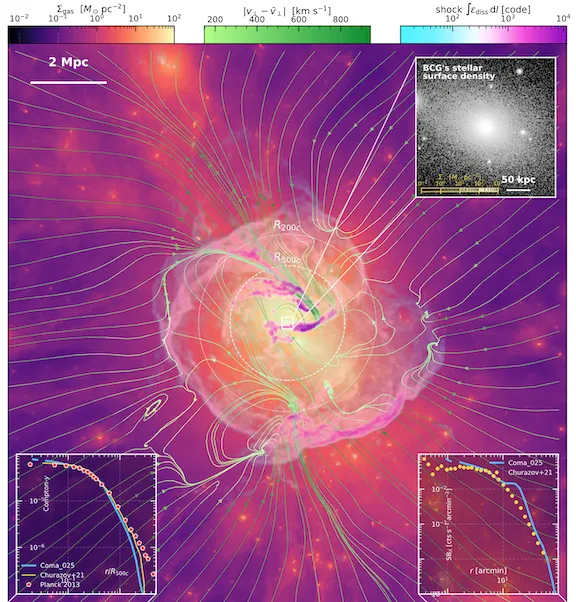
Other highlights include a new high-resolution Bayesian reconstruction of cosmic large-scale structure out to redshift 0.7, spanning a volume of (4 Gpc/h)^3 and validated against CMB lensing and kinetic Sunyaev-Zel'dovich observations; a suite of 50 constrained simulations of the Coma galaxy cluster comparing predicted X-ray and thermal profiles against eROSITA and Planck data; and a study of early black hole growth at redshifts above 9 exploring how different accretion prescriptions can reproduce the massive black holes recently discovered by JWST. The release also includes an expanded second-generation CAMELS simulation suite varying 35 parameters of the IllustrisTNG model; a critical evaluation of neural generative models for field-level inference showing that standard metrics can miss important failures in posterior uncertainty estimation; a new analysis of dust attenuation curve modeling in galaxy simulations; and a method for cosmological rescaling of merger trees that dramatically reduces the computational cost of training semi-analytic galaxy formation models.
Abstracts, BibTeX entries, and arXiv links are available at learning-the-universe.org/splash.