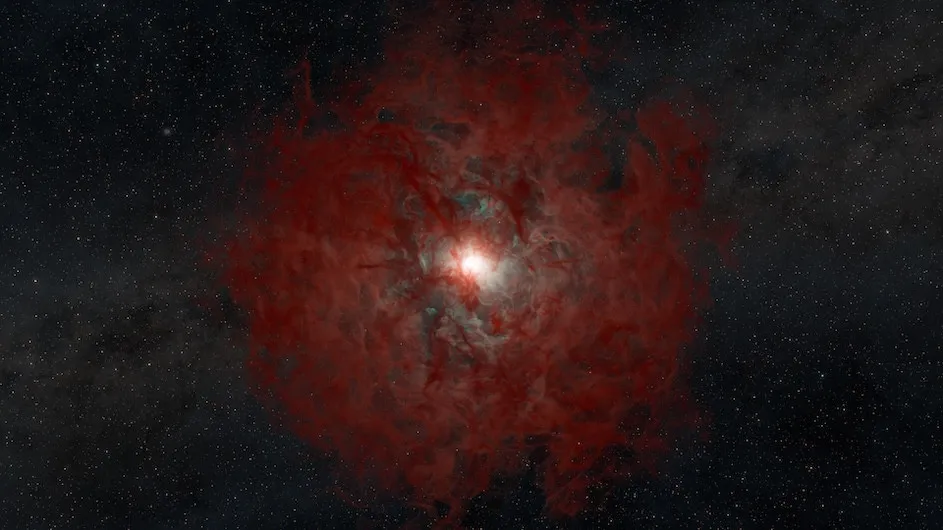
A massive star in the Andromeda galaxy has collapsed directly into a black hole without exploding as a supernova, according to new research led by Columbia Astronomy faculty member Kishalay De. The discovery, published today in Science, provides some of the clearest observational evidence yet for a long-theorized phenomenon known as “direct collapse.” The star, designated M31-2014-DS1, was a hydrogen-depleted supergiant located about 2.5 million light years away in Andromeda Galaxy. Initially about 13 times the mass of the Sun and later reduced to roughly five solar masses after shedding material through strong stellar winds, the star brightened steadily in infrared light for several years before fading dramatically and disappearing, leaving behind a shell of dust. Rather than producing a brilliant supernova, its core appears to have collapsed inward completely, forming a black hole in near silence.
De and collaborators uncovered the event by combing through archival data from NASA’s NEOWISE mission, conducting the largest survey to date of variable infrared sources in the Milky Way and nearby galaxies. Guided by theoretical predictions from the 1970s that a failed supernova would leave a faint infrared glow from dust-enshrouded ejecta, the team identified the unusual, sustained fading of M31-2014-DS1 as a signature of direct collapse. “Stars with this mass have long been assumed to always explode,” De said. “The fact that it didn’t suggests that whether a star successfully explodes may depend on complex, chaotic interactions deep in its core.” The finding challenges standard assumptions about how massive stars die and suggests that quiet collapses into black holes may be more common than previously thought, reshaping astronomers’ understanding of stellar death across the universe.
Abstracted from Columbia news story here.