This summer, the Simonyi Survey Telescope at Vera C. Rubin Observatory, on the outskirts of the Atacama Desert in Chile, began to survey the entire southern sky. The telescope will collect data for 10 years, creating the most detailed, comprehensive survey of the night sky ever taken. The survey is called the Legacy Survey of Space and Time (LSST).
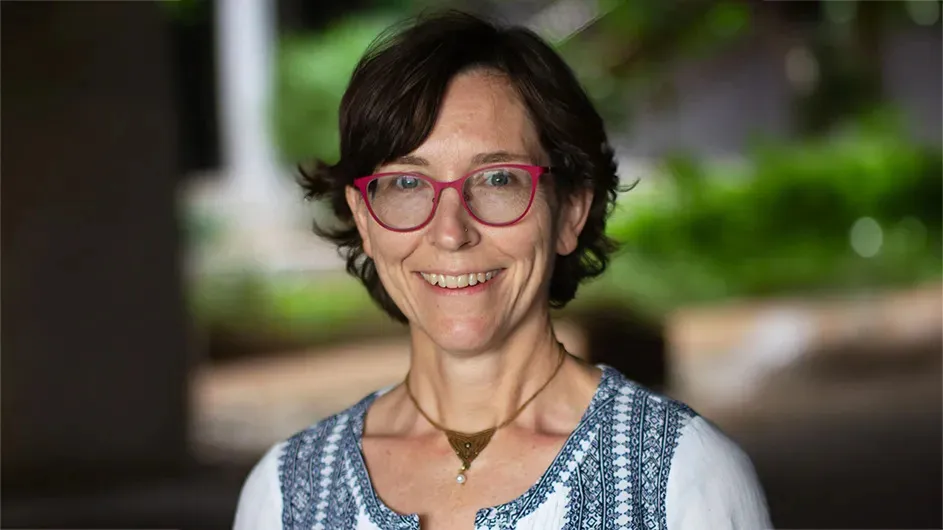
Jennifer Sokoloski, a research scientist at Columbia, is the chief scientist at the LSST Discovery Alliance, a consortium of more than 40 institutions (mostly universities) that are working together to envision, design, and help fund programs that will enable scientists to make discoveries with Rubin Observatory data.
Rubin Observatory will collect huge amounts of data. The aim of the LSST-DA is to figure out what the research community needs to make good use of that data, and then design and launch programs to meet those needs. Rubin is a groundbreaking facility that’s going to change how we do astronomy, simply because of the amount and richness of the data it’s already starting to produce.
Columbia’s representative to the LSST Discovery Alliance is Kathryn Johnston, who also helps oversee a postdoctoral fellowship LSST-DA runs. She’s very involved in shaping policies that will increase the impact of Rubin data. Her research with Rubin data will focus on using stellar streams to understand the structure and evolution of the Milky Way. Mary Putman also plans to use Rubin data to investigate galaxy formation and evolution.
Also within the department, Kishalay De recently received one of LSST-DA’s rapid-turnaround grants for Rubin science, focusing on stellar transients, objects that erupt or change with time. Columbia’s past representative to LSST-DA, Marcel Agüeros, will likely use Rubin data to understand the relationship between stellar age, rotation, and magnetic activity. Viraj Karambelkar is part of a network of postdocs planning to work with Rubin data that is organized through the Discovery Alliance. He also plans to use Rubin data to study cosmic explosions, including events that produce both light and gravitational waves.
For more details and excerpts of an interview with Jeno, see the Columbia News Article on the LSST-DA.